
For PR and communications teams, the narrative used to be shaped by journalists, analysts, and search results. There’s a new, faster-moving voice in the mix — and it speaks with total confidence to thousands of people, with no byline you can call.
When someone asks ChatGPT, Claude, or Perplexity about your company, the answer they get is your reputation in that moment. And sometimes it’s wrong.
The new failure mode
We routinely see AI engines:
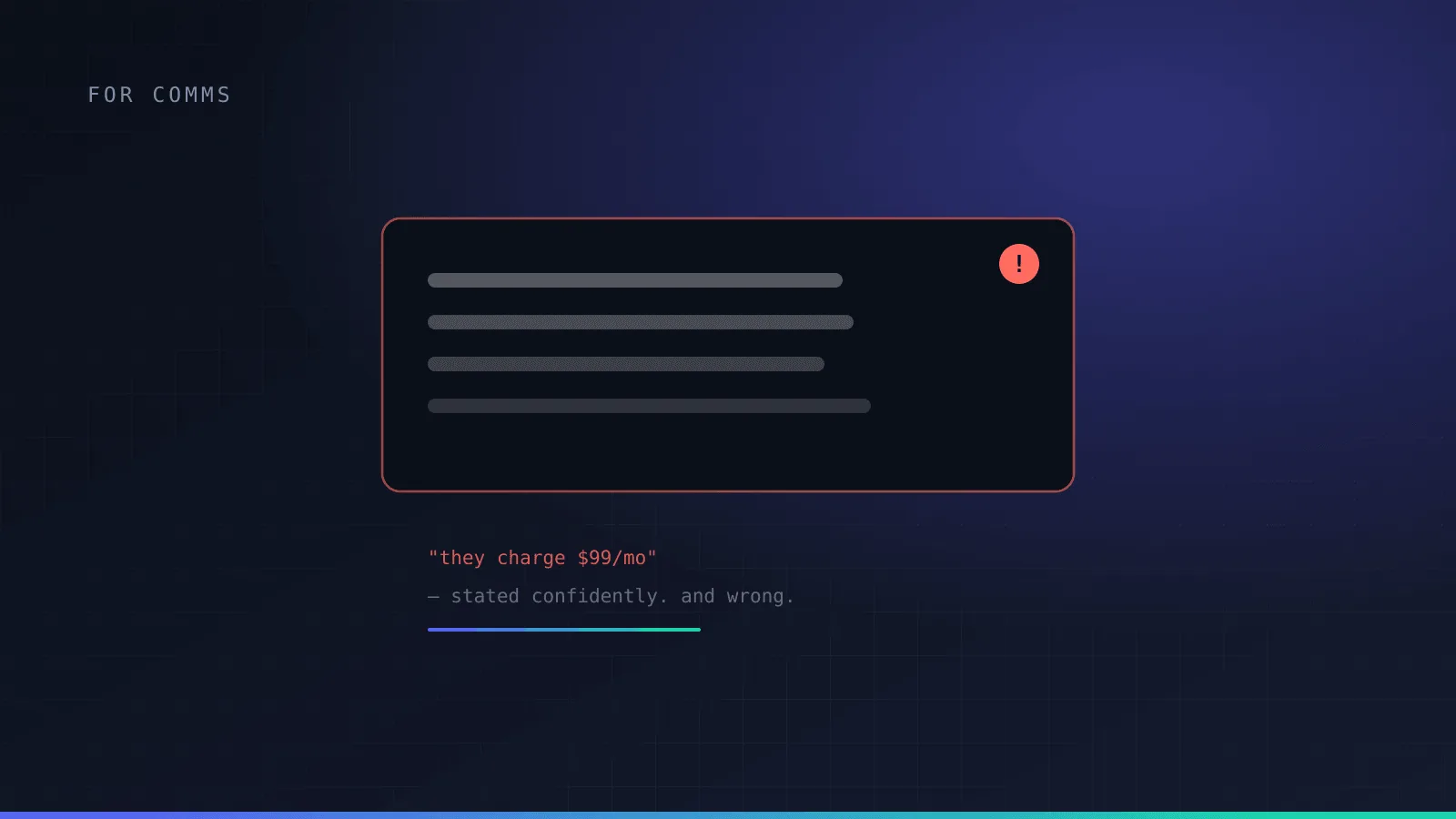
- quote outdated pricing (“they charge $99/mo” after you moved to $149),
- repeat a critical Reddit thread as the authoritative take,
- state plain factual errors about products, leadership, or funding,
- frame you with negative sentiment drawn from a single loud source.
The danger isn’t just that it’s wrong — it’s that it’s wrong confidently, at scale, and invisibly. No press clipping alerts you. The first you hear of it may be from a prospect or a board member.
What AI reputation management actually involves
It’s a discipline with three parts:
- Monitor. Track what the engines say about you — sentiment, factual accuracy, and the sources they cite — continuously, not once.
- Map. Identify which URLs are driving the narrative. Usually a handful of sources do most of the damage (or the good).
- Remediate. Correct or update the sources models trust, seed accurate and well-structured information the engines can pick up, and re-test until the answer reflects reality.
Why it’s different from traditional ORM
Classic online reputation management targets search results and press coverage. This targets what AI synthesizes and cites — a different surface, with different mechanics. Burying a bad link on page two of Google does nothing if the model keeps citing it. You have to address the underlying sources the engine relies on.
Get ahead of it with alerts
The goal is to hear about a shift from your monitoring, not your customers. Sentiment and accuracy alerts across engines let comms respond before a confidently-wrong answer compounds.
This is fast becoming a core comms function. See AI reputation management for PR & comms, or get a free snapshot of what the engines are saying about you right now.
Found this useful? Run your own domain through our tracker, the fastest way to see where you stand.
Get a free visibility check